Wednesday, January 7, 2026

Film

The Minolta Maxxum 5 was an 35mm SLR camera manufactured in the early 2000s that featured autofocus and other functions that would later be integrated into DSLR cameras, and was one of the last 35mm cameras made by Minolta before merging with Konica and pivoting to digital cameras exclusively. It was a piece of tech that bridged old school with new school, and in some ways represented where I was when I got it in the mail from an old friend. 

I was in my early 20s, uncertain about my future and my place in it, lonely and chronically online. I reconnected with a friend who I'd known since kindergarten, and we bonded over our mutual love of music, art, and Tumblr memes of the 2010s. I had every intention of shooting with the camera she'd sent, especially since I'd fallen in love with shooting film back in high school, but I didn't know where to get film or the batteries for the camera, so it remained on my to-do list. Years went by, and we drifted apart. It wasn't a blowout or with bad blood, but the quiet parting of ways that time has a way of facilitating. We both got married, she started a family of her own, we faced our own triumphs and tragedies, but it weighed on me that I never showed her the world through my eyes like she'd asked.

In 2024, with a little more disposable income than before and knowledge of where to get film and batteries (the pharmacy, who knew?) I started shooting around, unsure if the camera even worked. 

Sorry to keep you waiting, Tanya. Here are a few images I shot on 35mm:

Wheeler Gorge, Ojai, 2024
Kearsarge, 2024
Kearsarge, 2024
Kearsarge, 2024
Steph, Kearsarge, 2024
Table Mtn, 2025
Table Mtn, 2025
Table Mtn, 2025
Steph, Table Mtn, 2025
A Hawk and a Rainbow, 2025
Johnson Rd, 2025
Johnson Rd, 2025
On Top of My Dresser, 2025

Sunday, January 26, 2025

Biking for the Inyo

I feel like my childhood was pretty similar to a lot of kids in the 1990s; Teenage Mutant Ninja Turtles, Saturday morning cartoons, pillow forts, and getting bullied by my siblings were regular parts of my life in the last decade of the last millennium. However, I do feel like my upbringing-- and the majority of my life, really-- were uniquely special because of where I lived. 

Looking north from the valley floor, April 2014
The Owens Valley is a place near and dear to me, and though I've talked about it at length before in other posts it deserves praise at every opportunity. It lays between the eastern side of the Sierra Nevada and the western side of the Inyo Mountains in Inyo County. Despite being one of the largest counties in California, it only contains about 2% privately owned land with the rest being split between the National Park Service, The Forest Service, Bureau of Land Management, and the Los Angeles Department of Water and Power. It's a beautiful, harsh high desert environment that has been host to Native peoples for thousands of years and unique geology and ecology since time immemorial. Scars exist on the landscape from attempts to extract resources, from water to minerals, but despite the damage done by colonizers in the past Inyo County and the Owens Valley remain a natural wonder. 

The issue these days, though, is the same as it's been for the last couple hundred years. People look to take what the land can offer. The Los Angeles Department of Water and Power, or LADWP, still extracts water from the valley floor. Mining companies still look to secure contracts to extract gold, silver, and lead from the ground, promising jobs in exchange for environmental degradation and invasion of traditional Native lands. I've been fortunate enough to see the Owens River go from a dried swath of desert to a lush, green sea of life along the valley floor. Seeing the rains from the early part of the decade flood the Owens Lake, and seeing the water reflect the mountainsides for the first time since LADWP drained the lake in 1913, is something people might never see again. I've witnessed what nature can reclaim, and what it can bring with proper help from agencies looking to help it. 

Friends of the Inyo is one such agency. They've played a role in stewardship and policy to help protect and serve the Inyo National Forest and the areas within Inyo and Mono counties. Their mission is "to protect and care for the land and water of the Eastern Sierra" which means a lot to me. 

Now, a brief note about my history with bikes:

Like a lot of kids, I had bikes growing up. At one point early in high school I decided to take my bike down Mazourka Canyon Road, outside of my hometown of Independence. The bike itself was cobbled together with parts from other bikes, and even though it wasn't much to look at it did what it was supposed to well enough. That is, until, after riding to the end of the pavement five miles away in 105 degree desert summer heat, the rear tire went flat. Fortunately for me, after walking for awhile I got a ride from some of my friends dads who were driving through for work, so I only got a little sunburned instead of mummified and dead. Much later, in my 20s, I'd ridden a route with some friends on an old Schwinn Traveller with a warped rear wheel. That day lead me to running since running shoes are cheaper than a bike, but since then I've gotten back into riding bikes. I now go farther and faster than before-- thanks in no small part to running for so many years now-- and I've decided to do something worthwhile with my new cycling abilities.

This April I'm planning to go to Las Vegas to ride the Tour de Summerlin. The team I'm on, NevCali Riders, is riding for a variety of causes, and I'm fundraising in support of Friends of the Inyo. I hope to raise funds for the organization and awareness of what they do and represent. If you can donate, let me know! I hope you help support the cause to respect and protect Payahuunadü. 

My heart, my little bike shorts, my beefy legs, and I would greatly appreciate it if you can.

Monday, January 20, 2025

The Dregs

I've said before that I am a fan of good coffee. Very little compares to a well made cup of high quality coffee on a cool, quiet morning, though I do see the value of a cup of cheap coffee because I'm not the snob I used to be. Still, I try to buy good coffee when I can; if I'm able to support organic farming and fair trade coffee then, for the sake of the people producing my daily caffeine fix and the land that grows it, I'll do it.

Because I make my coffee the same way every day-- two tablespoons of ground coffee for every cup, and usually three cups between my wife and me-- sometimes I'll end up with just a little extra left at the bottom of the bag. Normally I'd use the last bit in a bag of coffee with grounds from the new bag since I'd be drinking it eventually anyway. Some people just dump the remainder into a new bag of coffee, and apparently some people throw it away-- which is wild to me. 

At some point, though, I decided to take the little bit of coffee I had left in a bag and saved it in a jar. Over the course of weeks I'd try different brands and roasts of coffee, and once a bag was almost through I'd take the little bit left in the bag and add it to the jar. Eventually enough coffee ended up in the jar to make a full pot of coffee.

I call it the dregs. 

Some folks during the early months of covid had "infinity bottle" projects, and I'm no exception. The concept is, essentially, that you take a small amount of whiskey (or any spirit, really) from bottles you enjoyed and blend them together in what ends up being a highly custom blended whiskey (though it's kind of a glorified and more notated Kings Cup). As whiskey is added, the flavor and character of the contents changes, and it becomes a new experience over time. This, along with not wanting to waste perfectly good coffee, was the reason I stared saving the little remainders of coffee in a jar; I wanted a unique cup of coffee that also wasn't so wasteful. 

However, unlike whiskey, coffee gets stale and loses flavor over time. It's why most coffee is nitrogen packed or vacuum sealed, so mixing old ground coffee in an old repurposed pasta jar isn't going to yield the same sensory experience as, say, blending a 12 year old Islay Scotch with a quality Kentucky bourbon. You won't find the dregs of whatever mix of coffee I got on sale served in a high end cafe in Paris. 

Here's the thing, though; I ain't picky. I appreciate carefully crafted artisan roasted coffee grown in small family farms served in hand crafted ceramic ware in high end coffee shops, but if I have a cup of three-hour old Farmer Brothers hotel lobby coffee in front of me I'll drink it too. If I have a mix of old coffees from the last couple months, and haven't gone to the store to get more coffee yet, I'm more than happy to see how the dregs is tasting. It caffeinates, it isn't wasted, and it has yet to taste too bad, so it's a win-win-win in my book. 

Yesterday I hand ground some organic, fair trade beans and brewed it in a press. Today I'm enjoying the dregs from the coffee pot, and I appreciate them both for what they are. 

Saturday, December 14, 2024

Bike Lanes in Lancaster: Some Thoughts

I'm planning on racing with this
thing in April, look out for that.
Last month I decided to buy a pretty nice road bike off Facebook Marketplace. It's a Trek Domane 2, and it came with front and rear lights, a seat post bag, along with a few other extras, and for an entry level road bike it is a hell of a get. Although I already had a bike-- an REI branded mountain bike outfitted with a rack and panniers that I love dearly-- I wanted something a little lighter and faster, so now I have the bike I can take to the grocery store and one I can take to charity rides and use as an excuse to wear Lycra shorts and wraparound sunglasses. 

I still go running more than I go cycling, though, and part of that is because of where I live. The first time I took my REI mountain bike for a spin I hit a pothole in the bike lane and scraped my leg pretty badly (I finished that damn ride, even though the tumble took off some of my tattoo). Often, when driving to work, I see people using the bike lane as their own personal expressway, which doesn't offer much confidence when it's my fleshy body and 20 pounds of aluminum versus a half-ton of Nissan Maxima with a driver on their cell phone going 65 miles per hour. Running isn't much better since I've nearly been splatted by drivers who forget pedestrians get the right of way, but at least I'm not going as fast as I would be on a bike and I'm able to stop a lot faster. 

I was thinking about all this because of a post on Facebook I saw from the mayor talking about the benefits of bike lanes, with a link to a Fast Company article that-- hilariously-- can't be found. 

"I am normal and can be trusted with
running a city of 174,000 people."

He talked about how, while traffic might be a little slower, bike lanes are important from a safety standpoint, then offered no elaboration as to how they make roads safer. Granted, I'm just some guy who uses bike lanes and sidewalks throughout the city, but I think he's half right in this case. 

The BLVD, the downtown area of Lancaster, California, is his pride and joy, and is an attempt in urban design that almost works. It offers walkable shops and restaurants, a farmers market every Thursday during the warmer months, mixed use buildings with upper floor apartments and lower floor store fronts, and-- most importantly for the purposes of this post-- mixed use streets for bikes and cars. The infrastructure for being less car-centered is cool in theory, but it's only a quarter mile strip of street in the city, and car parking takes up a lot of space in that quarter mile.  

Essentially, my point is this: R. Rex Parris is almost right. Bike lanes, and by extension pedestrian-friendly infrastructure, is good for public safety, but primarily because it reduces the likelihood of being in a car accident. Fewer cars means fewer accidents, and fewer accidents means fewer injuries and deaths as a result of driving. However, the east side of the city-- the poorer side, where I live-- is in desperate need of infrastructure repair. Sure, I can ride my bike to Aldi pretty easily if I need some milk and whatever insane limited-run shit they have (I really hope they re-release the Aldi branded shoes), but the bike lanes shoulder up to car traffic going a mile a minute, and the state of the pavement makes for a rough ride whether you're on a bike or in a car. Riding a bike to The BLVD is doable from the east side, but is often a hair-raising experience. 

Having goods and services accessible without the need of a car would do a lot for the well-being of the community, which means more mixed-use neighborhoods, pedestrian-friendly infrastructure like protected bike lanes and sidewalks with actual shade during the triple-digit heat of the summer, fixing rutted and potholed streets beyond the gentrified strip in the center, and incentivizing biking, walking, and public transit in general. It's a lot to ask of a city built up by suburban sprawl but, if the mayor wants to talk about bike lanes and safety, he should consider making the streets actually safe to use. 

I know the city has a lot of issues to address, but hopefully infrastructure improves so bike lanes can actually make things safer. 

Tuesday, October 29, 2024

A Brief Dive Into The Monster Mash

It's that time of year again for horror movies, pumpkin carving, and novelty songs about skeletons-- spooky, scary, and otherwise-- among other spooky subject matter, like the 1960s classic "The Monster Mash." Recently there has been some contention with the song, with some people claiming it's a song about the Monster Mash, and that we don't really know what it sounds like, in much the same vein as The Greatest Song In The World in Tenacious D's "Tribute."

While interesting, I had a thought in the shower that sent me down a really, really pointless rabbit hole that prompted me to dust off my blog and hammer out a theory nobody cares about nor asked for.

The Monster Mash was initially a dance: the monster from his slab began to rise and did the Mash. The ghouls came from their humble abodes to get a jolt from an electrode and did the Mash. It's easy enough to believe that it's just a dance and not a song they're talking about in The Monster Mash.

The song, however, later says they played the Mash, which throws a wrench into the assumption that it's only a dance. Dracula shakes his fists and says, "Whatever happened to my Transylvania Twist?" which, in reply, is stated that it's now the Mash, it's now The Monster Mash, et cetera. Final nail in the coffin (pun intended) for knowing what the song is.

Except it's not. 

The 1962 album The Original Monster Mash by Bobby "Boris" Pickett and The Crypt-Kickers does, in fact, have a track called "The Transylvania Twist." It can be inferred that, if they said The Transylvania Twist is now The Monster Mash, that the song played in "The Monster Mash" sounds like "The Transylvania Twist" which solves the mystery of what they played in "The Monster Mash" sounds like.

This, however, leaves the mystery of what the dance might look like. I don't have a definitive answer to what the dance of The Monster Mash might look like, but considering ghouls got a jolt from an electrode, the monster-- who I'm guessing is like Frankenstein's monster-- also got a jolt, and that The Transylvania Twist could be a variation of the original dance, I'd imagine the dance being a jerking type movement like a zombie getting electrocuted while doing The Twist.

That, of course, is all conjecture, but it's something to think about if you want a topic to talk about at the next Halloween party to ensure you're not invited next time. 

Creep it real and have a happy Halloween. 

Sunday, February 25, 2024

In Memoriam: My Shorts

It is with a heavy heart that I have decided to retire my favorite pair of running shorts. 

I bought a pair of Patagonia Strider 5 inch shorts (I think) in 2017 (I think) at my local outdoor gear shop (Elevation Sierra Adventure Essentials, that I'm sure of), not realizing that the shorts I'd run in previously were two inches longer. I was self-conscious about wearing them when I ran because my legs were ghostly white. It was bad enough running in longer shorts, but showing more thigh was not something I was used to. However, having only a couple other pairs of shorts meant I had no other choice but to wear them eventually if I wanted to go for a run before laundry day. Besides, I ran in the desert outside of town so no prying eyes would be blinded by my pasty gams. 

I grew to love those shorts. They taught me how to not give a shit about how my legs looked and to embrace the lightness and freedom of movement short shorts provide. I tried to get another pair of Strider shorts but, of course, the new versions of them weren't as good as the original. The rest of my shorts-- all 5 inch inseams now, of course-- have been fine, but not quite as good as those green Patagonia ones. 

I ran my first marathon in them. I tackled mountain trails, desert scrambles, city streets, and suburban sidewalks in them. They were in my rotation just about every week, even as other pairs of shorts blew out and fell apart. 

Last week, after my Wednesday morning run, I was hurting. It wasn't soreness from the run, and I didn't pull anything; it was from chafing. The hundreds of miles of thigh rubbing, sweaty unmentionables, and farts finally took their toll on my thin polyester butt-cover. The holes in the inner thigh no longer keep my legs from rubbing, the inner liner no longer supports like it used to, the elastic in the side pockets is going bad, and for the sake of my skin, the contents of my pockets, and my modesty, it's time for them to retire. It has happened with other shorts before, and assuredly it will happen again with others, but I can't help but feel a little bummed that my favorite pair of running shorts has finally run its course. 

I plan to mail them to Patagonia to have them recycled, so maybe the blood, sweat, and tears I've put in these shorts will live on in other well-loved gear in the future. 

Maybe some of the farts, too. 

One can only hope.

Saturday, January 28, 2023

An Overly Detailed How-To for Pretty Good Coffee

I am a self-professed recovering coffee snob. While I appreciate a finely crafted cup of coffee, my opinions on it are much the same as my views on pizza: Even a mediocre pizza is still pizza, and thus is still pretty good pizza. It's a good cup of coffee if you like what's in your cup, and I hold that as truth. 

However, on weekends I like to treat myself to a little meditation in a cup by making coffee with my French press. It's a process that I have practiced for years, and I have worked this practice to make an end product I thoroughly enjoy, so I'd like to share that with you.

First, I wake up earlier than I'd like. As I've gotten older (and no longer work until 11pm since I left the hotel industry), I've found my body likes to start the day before 6:30am, and generally likes to get going by 5:30am. So, silently, as to not wake up my spouse, I make my way to the kitchen and gather my tools for a good batch of coffee.  


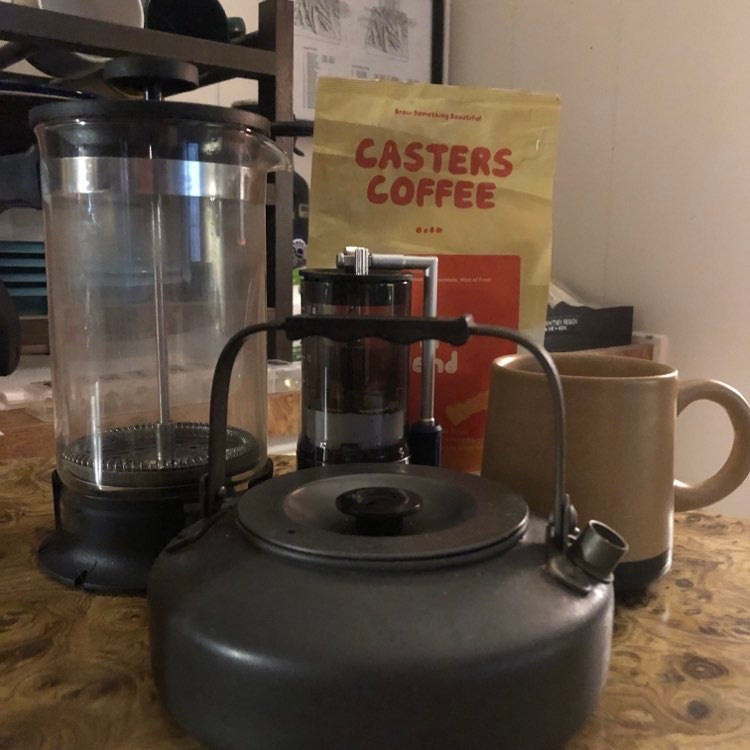
I like a good whole bean coffee when making coffee in a press. Caster's Coffee is a local roaster in Lancaster, California, who trains and employs unhoused people in the community to help elevate them from homelessness. They roast beans from small, independent farms from Central America and Africa in their facility not too far from my house. I like their Poppy Blend; it's bright, mildly floral, and even-bodied, though their Challenger Blend dark roast is great too. 

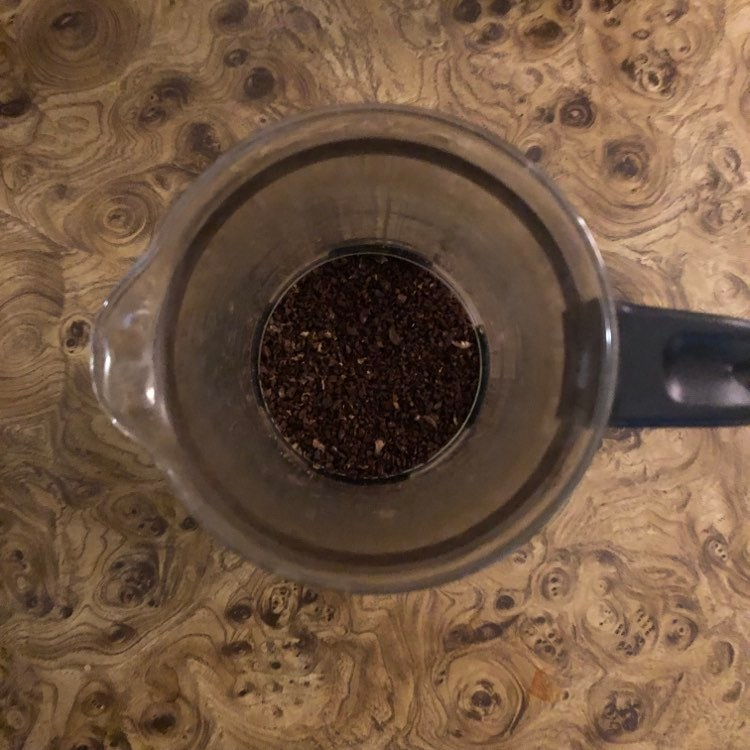
I have found that grinding beans by hand in a burr grinder produces better results than with an electric blade grinder; a burr grinder gives a more consistent grind than a blade grinder so there isn't so much sludge on the bottom of the cup, though a blade grinder is fine for drip coffee in my opinion. Grinding by hand is a slow process but one that allows me to appreciate the aroma of the coffee and the feel of the grounds, and grinding whole beans allows the oils inside them to be released as fresh as possible, making a more complex and delicious cup. 

I measure out about three tablespoons of beans per cup-- not like per 8 fluid ounces, but for each cup of coffee I plan to drink, which is more like 12 ounces or so I think. Generally, with a drip machine, I'll do one tablespoon of ground coffee to 6 ounces of water, but I like a more robust batch of pressed coffee. Plus, I find a coarser grind can make a batch of coffee weaker, so I err on the bolder side. 

I fill my kettle with two coffee cups of water, plus another third or so to compensate for the water absorbed by the grounds. The kettle itself is an Optimus Terra that I got from Elevation Sierra Adventure Essentials years ago after using it to transfer eggnog to my first world-renowned Independence Fruitcake Festival. Over the years-- and many cups of coffee and tea-- I've come to learn the sounds it makes when the water is the temperature I want. The recommended temperature to brew coffee is 200F, and most hot water dispensers and electric kettles will get to about that, but as long as the water is just below boiling you're good. 
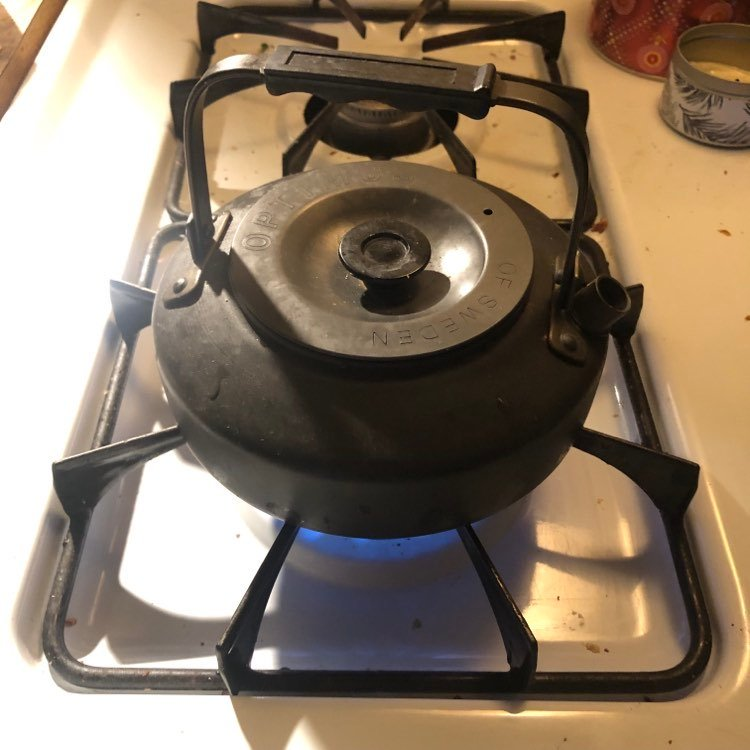

After my kettle gives a low pitched rumbling and wisps of steam start flitting out of its little spout, I slowly pour the water onto the grounds in the press in a circular motion, being mindful to not dump in all the water at once. A nice frothy bloom is produced, and even though some people think it's sacrilegious I like to stir the grounds and water to better incorporate the whole mix. 

The press itself is one I found in Ikea some years ago, but before that I used a stainless steel one my brother found in the lost and found of the hotel we worked at back in 2009. The mesh strainer of the steel one was pretty ratty by the time I got the Swedish mass-market replacement, but it still worked fine, and I use the old metal press whenever I go camping. For home use-- and the sake of easier cleanup-- the little glass one with the melted base from that time I set it on a hot burner does the job quite well. 
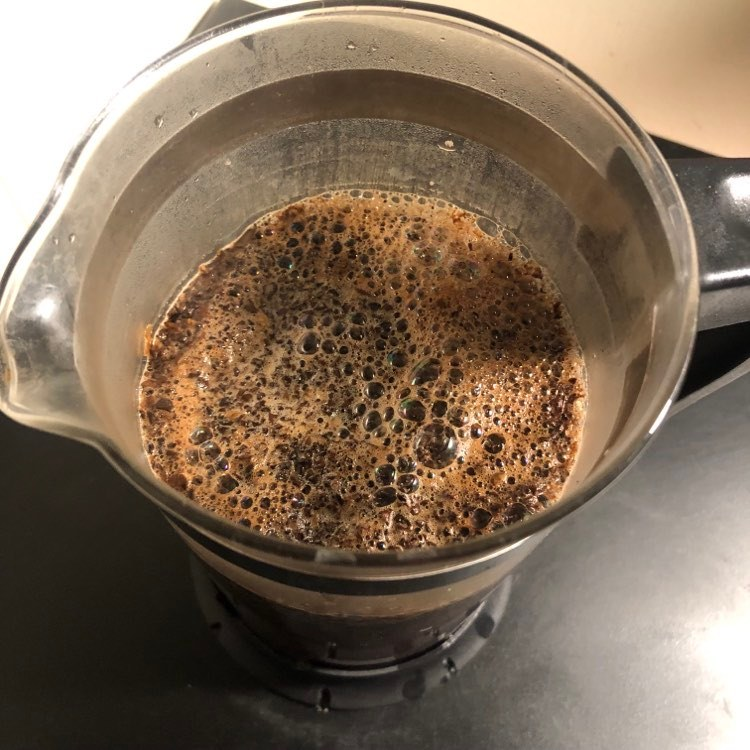

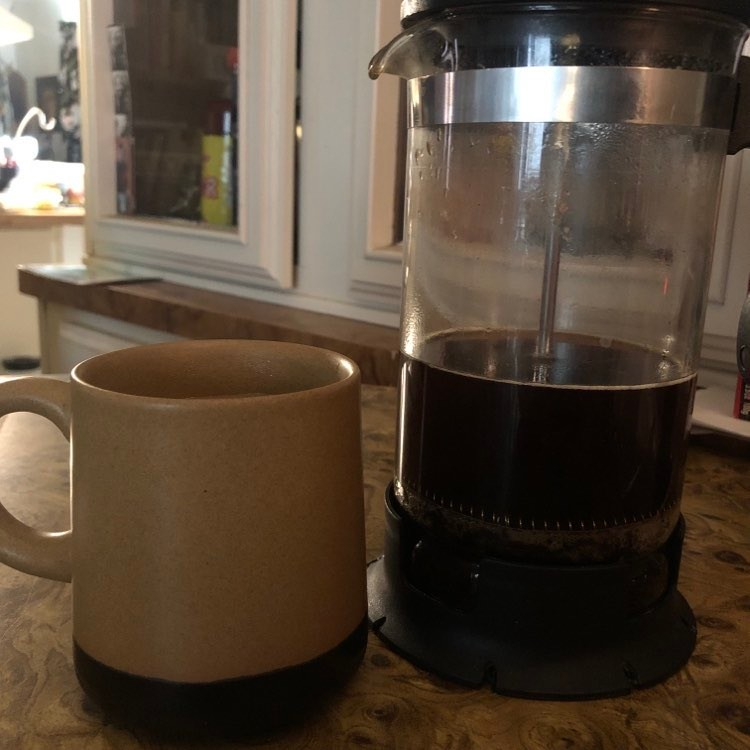
I let it sit and steep for about 15 to 20 minutes after pouring the water. Theoretically it's good to go after 7 to 10, but I like to give it an opportunity to rest and really let the water extract all the goodness it can. During that time I occasionally tidy up around the house, open up the doors and windows during the warmer months to let in fresh air, open the blinds and curtains during the cooler months to bring in sunshine, or take a quick shower to help start my day, but generally just appreciate the stillness of the early morning and the little sounds of life outside. 

After that time has passed and the coffee has cooled to a drinkable temperature, I slowly depress the plunger of the press, and with that it's ready to serve. I slowly pour myself a cup to ensure as little mud as possible from the bottom of the press gets out, and with the first sip take time appreciate the warmth, aromas, and flavors I worked to produce. 


I reserve this for my weekends because, admittedly, it's time consuming. During the week I program a drip machine with pre-ground coffee to have a pot ready as soon as I roll out of bed, and as a functional beverage it's a great thing. After all, I don't always have two hours to dedicate to making and drinking a couple cups of coffee, and a convenient way to access caffeine before a 6:30am work shift is a beautiful thing I wouldn't want to give up any time soon.

However, I think it's important to set a day aside, or at least a morning-- any time of day, really-- every now and again to dedicate to a methodical and meditative process. It's easy to feel detached from things, and making things by hand is a way to connect with those little joys we sometimes take for granted. Making a quilt and pouring love and attention to its construction helps you appreciate it even more when you're snuggled up on a cool evening. Building a birdhouse gives you a place for the wildlife to hang out and something nice to look at. Growing your own tomato gives a sense of pride along with a third of your BLT. Cooking a meal from scratch helps you appreciate the nourishment it provides, and allows you to practice making something you like if you're not so talented in the kitchen (like me). Brewing coffee in a slower, low-tech way helps you appreciate the stillness of the morning and the quality of a good cup of coffee. 

Make something nice for yourself. You'll enjoy it. 

Wednesday, May 18, 2022

The Vegan Chicken Nugget Reviews Nobody Wanted or Asked For, pt. 1

One question people bring up when complaining about non-meat meats is, "Why don't they just eat real meat if they have to make it look and taste like meat?" as if seasoned ground beef looks and tastes like a cow. Granted, a lot of plant-based meat substitutes have binders and fillers that don't make them particularly good for you, but I'm not going to say the Beyond Famous Star from Carl's Jr. is in any way a health food item. It's more environmentally friendly, sure, but it's still junk food at the end of the day. 

That said, I like chicken nuggets. They are a meat product that is so thoroughly process and reliant on artificial flavoring that I could at least spare some birds lives and carbon emissions and get down on some equally mysterious plant-based varieties. Living in the 21st century has made finding these options pretty easy, and I have been trying a number of them over the last few months when I leave work and feel too lazy to actually cook something or go through a fast food drive-thru. All the plant-based nuggets I've tried look like a chicken nugget, but where do they stand flavor-wise?

Let me share some of what I've found with you:


Gardein Chicken Nuggets

Being a big name in the faux-meat game, I expected a lot from Gardein, but they only got it kind of right with their standard issue nug. The texture was soft, but a little too soft, even after cooking them at the manufacturer's recommended specifications. The breading was inoffensive, like a standard nugget, and the flavor was actually pretty alright, akin with mechanically separated chicken. If you're looking for an easily accessible and relatively cheap nugget to keep in your freezer this would be a good start. 7/10

    Rebellyous Plant Based Nuggets

    The company Rebellyous prides themselves in making products that look and taste like chicken, and they did well to deliver on that with their nuggets. They're soft, but not too soft, and the breading is pretty good. The thing that impressed me was how they managed to accurately recreate the flavor of actual frozen chicken nuggets-- not exactly chicken, but not exactly not chicken. They taste a lot like the kind I used to microwave when I was in high school, so I would get them again if I was looking for a not-meat meaty snack throwback. 8.5/10

    Simulate Nuggs, Spicy

    The packaging is extremely unassuming, but Simulate Nuggs are super good-- especially the spicy variety. The texture is as close to a 1-to-1 as I have found to the real deal, and the breading is crisp and dense like a spicy nugget should be. It actually tastes like chicken, and the spicy kick elevates the experience even more by leaving a little heat behind after each bite. Plus, Simulate also has Dino-shaped Nuggs, so the brand overall gets high marks. I'd easily get them again, not just because they're good as a meatless nugget but because they're a good nugget in general. 9.5/10


    The fact that this is part one of a series speaks to how many plant based options for foods there are and how much I enjoy junk food. I'm kind of surprised there aren't more plant-based nugget options in fast food restaurants besides KFC (which I haven't tried yet since the KFC nearest to me doesn't even have chicken half the time, like how are you going to have a chicken restaurant without chicken? C'mon. Get your shit together.) but I get the feeling that, with faux meat options offered at more places across the country, vegan nuggets will come to a drive-thru near you sometime in the near future. Until then, I'll keep looking at the freezer section and report back with what I discover. 

    Happy snacking! 

      Monday, April 4, 2022

      A Brief History of Lancaster, California (and My Visit to The Western Hotel Museum)

      When I was in high school I wasn't very focused, and I struggled with a lot of subjects. While I did well enough in English class my real interest was in history, so I spent a good chunk of my teen years studying local events by reading old books in the library under the court house in Independence, California, and spending a summer working at Manzanar National Historic Site. Throughout my 20s I continued to bone up on the history of the area, the town I lived in, and the nearly century-old hotel I worked at for over a decade. You could say I'm something of a history buff, but specifically for wherever I happen to be.

      In 2020 I moved to the Antelope Valley for the... fourth time, I think. It's an area notable for being the place Afroman came from and where they tested a lot of supersonic aircraft, but I feel the Lancaster-Palmdale area doesn't get a lot of notoriety otherwise. That's part of why I started looking into the origins of how the town came to be and why it exists in the first place. After reading through "Images of America: Lancaster" from Arcadia Press and visiting the Western Hotel Museum on The BLVD in Lancaster, I've been able to piece together a quick-and-dirty history of how the city came to be.

      The area was inhabited by the Kitanimuk, Serrano, and Kawaiisu people for many generations before white settlement, hunting the antelope that gave the valley its name. Though they moved a fair bit, the peoples who lived in the area did establish regular camps in the valley floor, a few of which have been found in recent decades. A great resource to utilize if you're looking to learn more about the people of this area is the Antelope Valley Indian Museum, located east of Lancaster (though be sure to check your colonizer mindset at the door if you want to get the best experience possible). 

      Nobody is entirely sure why Lancaster is even called Lancaster. The collection of shacks where workers lived along a slow spot of the Southern Pacific Railroad would eventually become a town, but nobody is certain if the name came from the workers that possibly immigrated from Pennsylvania, a guy with the last name of Lancaster, or the birthplace of the guy who founded the town, Moses Langley Wicks (though he apparently wasn't even born there). Whatever the origin of the name might be, it started as a place to pass through but soon became a site for agriculture after Wicks bought up 60 acres of land and sold off parcels to folks looking to farm. The city center, which is essentially the area around The BLVD and Sierra Highway, became a true community with a post office, general stores, and a lodging facility that would eventually be called The Western Hotel. 

      The oldest remaining building in the Antelope Valley-- and one of the oldest in Los Angeles County, from what I've heard-- The Western Hotel, originally called The Antelope Hotel, was built in 1888 as the sole hotel in Lancaster. In 1908 the hotel was sold to George Webber, a German immigrant who tried and failed to manufacture paper out of Joshua Trees (not only do Joshua Trees take 100 or more years to fully mature, the paper itself would degrade extremely fast). In 1910 he married Myrtle “Myrtie” Eveline Gibson Sullivan, a woman who moved to the area to help her lung issues with dry, desert air. During the Spanish Flu pandemic in 1918, because there were few other options, the hotel acted as a makeshift hospital, and during the Depression it served as refuge for people who oftentimes couldn't pay their bill for their room or meals. When George died in 1934, Myrtie took up operations of the hotel until she was sent to a convalescent hospital when she was 103 years old in 1971 (she passed away in 1978 at 110, which is nuts to me, but apparently testament to how well dry, desert air works for a persons health). 

      Soon after Myrtie died the hotel fell into disrepair, and was condemned and set for demolition by Los Angeles County. However, the community wanted to see the building preserved, so the Western Hotel Historical Society was founded. Volunteers worked to clear overgrowth from the lawn and to restore the building, and through the 80s the Lancaster City Council worked to restore the structure to become the museum that exists today. It now showcases original pieces of furniture and antiques from when the hotel was first in operation, along with artifacts from the areas Indigenous populations and local wildlife, the mining history of the area, and prominent historical celebrities like Judy Garland and John Wayne.

      The City of Lancaster, and the Antelope Valley in general, was put on the map by the railroad, and after boom and bust years with agriculture there came Highway 6-- now Sierra Highway-- and the aerospace industry. Companies like Northrop-Grumman set up operation near Edwards Air Force Base, and people like Chuck Yeager broke the sound barrier for the first time in the skies above the desert, but that's the part that most people know about. That, and Afroman, I guess. 

      It's easy to write off some places as nothing more than strip malls and neighborhoods of McMansions. The Antelope Valley has its fair share of mini marts, Walmarts, and housing tracts of homes that look to be copy-pasted from the same set of three blueprints, but there is history to the place. While there are many more hotels in the area catering to all kinds of different clientele-- including a new one on The BLVD--  the oldest one in the oldest part of town has a lot of information on this humble desert city. They're open every second and fourth Friday and Saturday of the month from 11am until 4pm, so be sure to check them out if you're curious. 

      Friday, August 27, 2021

      A Look At 'Wild At Heart' Horse Sanctuary

      Between having grandparents who lived on a dairy farm in the Central Valley and growing up in the middle of nowhere around horse and cattle pastures, I have had my fair share of experience around livestock. My experience mucking out corrals and tending to animals, along with having an open Saturday morning, were what lead me to the Wild At Heart horse sanctuary on the west side of Lancaster, California, after I saw a post on a local community page on Facebook asking for volunteers. 

      I drove out to 70th Street West and Avenue H on a warm Saturday morning to an unassuming horse property in the desert. Walking down a short dirt road past the farmhouse I found a sign indicating I was at the right place, and I waved at the first person I saw. A volunteer (I'm sorry I forgot your name! I'm really bad at names!) directed me to one of the founders, Leslie, and after a brief introduction and signing off on a liability waiver I got a hose and a brush and started scrubbing down water troughs. 

      A 501(c)3 nonprofit organization, Wild At Heart was established in 2015 to take in, rehabilitate, and adopt out horses in need in the Antelope Valley, and permanently board and care for horses that have special needs or high maintenance requirements. With over 30 years of experience with horses and their care, Leslie is well qualified to take on the role of a unique but much needed service in the area. 

      I'm glad I spent so many of my childhood and teen years climbing the fences in the fields outside my home town, because I did a lot of that going from corral to corral, dumping water and scrubbing the gunk out of horse troughs. It's also good that I'm accustomed to manure because one horse-- I didn't get his name, but he was a good boy-- saw the mud puddle I had created with his dirty trough water and decided to cool off by splashing around in it. While I was also hot in the summer sun I wasn't really intending to be in the splash zone of mud and manure, but that's what to expect with working with livestock; you're going to get dirty.

      Once all the troughs were clean and I pet as many horses as I could, I made my goodbyes with Leslie and told her I would be back. It was a pretty good workout, which would be enough for me to return, but it's more than that; I like being around horses. The opportunity to scratch their giant heads and pet their massive ears is something I don't often have these days, and knowing I can be a part of the welfare of animals in need is rewarding in its own right. Plus, with horses and cows, they poop. A lot. And they eat and drink. A lot. There's always a need for a helping hand at the sanctuary, and if I can give it I will. 

      If you're not afraid to get a little dirty or break a sweat, they have opportunities to volunteer on Saturdays and (I think) Wednesdays. If you want to check out the horses, try horseback riding, or want to adopt, they're open from 9am to 5pm, Monday through Friday. Plus, if you're looking for another fun way to support the organization, the 2nd Annual Cowboy Bash in Leona Valley will be held on September 25th and will have food, drinks, music, a silent auction, and pony rides, with proceeds going toward the sanctuary. Be sure to check them out on Facebook for more information.

      It's a great organization and another hidden gem in the Antelope Valley, and I hope you take some time to check them out!

      Friday, August 6, 2021

      My Attempt To Be Less Trashy, pt. 3: Clothing

      This is another installment of my series "My Attempt To Be Less Trashy" where I share things I have and do to try curbing my environmental impact. Like I've said before, even though I'm not the best at zero- or low-waste living, an attempt to be mindful is better than not trying at all, and you can read about my swaps and habit changes I've previously written about here and here.

      Clothing is something that has a serious impact on the environment. In the early half of the last century there were two seasons for clothes: Cold and Not-So-Cold. The average wardrobe wasn't typically too extensive (even though men often wore suits every day, they would have maybe a couple suits they wore in rotation). Today, thanks in part to companies wanting to turn a profit, there are up to 52 seasons for fashion-- one per week, just so fast fashion boutiques can pump out something new for people to buy. As a result, the textile industry is the second largest polluter on the planet. That doesn't even factor in the water used to wash garments after we buy them! There are things we can all do to curb our impact in regards to buying clothes, and a few things I've done are pretty easy: 


      Detergent strips

      Awhile back I started using laundry detergent strips, mostly to see what they were like. Considering liquid detergent is liquid because of it being mostly water, I didn't feel like spending more money on a plastic tub of blue-dyed watery soap. I used powdered detergent for ages for that exact reason too, but I figured the strips would make for less mess, and I was right. In my experience, detergent strips, which are about the size of a couple sticks of gum side-by-side, wash just as well as any detergent I've ever used, all while biodegradable and in a lightweight, recyclable package. Even switching from liquid detergent to powdered is a good first step to save water, and washing everything cold is a great way to save energy too, but if you want to save on packaging and overusing detergent, strips are a great option. 

      (Also, sidebar, they're great for travel if you don't want to pack liquid or powdered detergent in your suitcase!)

      Re-wearing clothes

      More often than not, I wear the same shirt at least a couple times before washing it. I wear my jeans and shorts a lot of times in a row before putting them through the wash, and flannels until they start to stink. I wash my chonies after every use, of course, and the clothes I run and work out in only get worn once before washing since they get pretty stinky pretty quickly, but by re-wearing a lot of my clothes I can not only save time doing fewer loads of laundry but also extend the life of my clothes by not washing and drying them so often. Plus, fortunately for me, I wear basically the same thing every day, so nobody has ever called me out for repeating an outfit. I doubt it would happen to you either, and even if it does it's their problem and not yours. If it smells fine and isn't too wrinkled wear it, who gives a shit.

      Buying used

      This goes for a lot of things, but clothing in particular is good to buy used. With so many new lines of clothes coming out every week, and apparently a market to buy a new outfit every week, a lot of clothes go to waste. Only 7% of people purchase used clothing, and only 28% donate used clothing to thrift stores, which is a problem because people buy five times as many clothes as they did in 1980. I still rock the $2 boots I found, and I've recently purchased a nice button-down through Patagonia's Worn Wear shop with credit I received from sending in a different Patagonia brand shirt in for repair. The company Darn Tough, which makes great socks, has a lifetime warranty on their products so you can exchange them instead of throwing out your old socks. There are ways to get clothes both affordably and with less of an environmental impact, and besides buying from companies that engage in sustainable practices in manufacturing the best way to do it is to buy secondhand. 

      Fixing what you have

      Again, this can go for a great many number of things, but repairing your clothes is one way to extend the life of your clothes. If you don't know how to sew, it's not too difficult to learn how to reattach a button or close up a hole in a seam of a shirt. Like I did with my $2 boots, if you have a pair of shoes that can be resoled you can keep a lot of material out of a landfill, and as I mentioned before, Patagonia's Worn Wear program can attempt to repair clothing you send in and, if they can't, they can repurpose the material of your clothing to be made into something else. I had an old pair of jeans that had a huge grease stain, but instead of tossing them I treated the stain until it was barely noticeable unless you really looked for it. and when they started to get holes in the I patched them up and wore them until they got too far gone, but even after that I made them into shorts. By using what you already have you can spare your wallet from buying the style of the week and the landfill from throwing out something with something repairable.


      You can also hang-dry your laundry, use old clothing for crafting projects like quilts and the like, or be naked (it might not work well in mixed company and it might get cold eventually though, FYI), but there are things we can all do to curb our impact on the environment when it comes to the clothes we wear. It boils down to being a conscious consumer and taking care of the things we already have, in our clothing and everything else. 

      Nobody likes a trashy person, and if you're like me and want to be less trashy there are choices we can make to be nicer to the planet. 

      Friday, July 30, 2021

      My Attempt To Be Less Trashy, pt. 2: Eating and Drinking

      This is another installment of my series "My Attempt To Be Less Trashy" where I share things I have and do to try and curb my environmental impact. Like I've said before, even though I'm not the best at zero- or low-waste living, an attempt to be mindful is better than not trying at all. 

      One part of life that I know I still need to improve on is in the realm of eating. Something like 40% of food is wasted in the US, and fast food packaging makes up something like 10% of total packaging waste globally, but I'm just as guilty as anyone of forgetting about spring mix in the fridge and grabbing Taco Bell. However, I have made some changes to improve on my impact with dining, and maybe these along with not opting for Crunchwrap Supremes when I get tired of digging through the cupboards will help reduce my impact in the realm of food and drink:


      My Hydroflask

      I love my insulated water bottle. I found it secondhand, and using it instead of buying bottled water has been an easy solution to reducing consumption of single use plastics. I have a small collection of Nalgene water bottles too, and while they work well enough my Hydroflask is both insulated, which keeps my water cooler when it's roasting here in Southern California, and made of steel, so it's virtually indestructible. It has a few dents and scratches but I know this bottle will last forever, whereas Nalgene bottles can break after awhile and single use bottles get thrown out as soon as they're empty. Any reusable water bottle is an easy first step toward using less single-use plastics (and a great way to remember to hydrate!) but I love my secondhand Hydroflask. A new one can be a little pricy, but it pays for itself with how many bottled waters you don't have to buy.

      A stainless steel lunch box

      When I'm working I like to pack a lunch, mostly to resist the siren song of Doordash and help spare my poor wallet, but also to prevent more food packaging from being unnecessarily wasted. I've used plastic containers for years to transport my workplace lunches, but they crack after awhile and end up unusable, so awhile back I invested in a stainless steel lunch kit. It holds my peanut butter sandwich and trail mix just as well as any plastic container has, and like my Hydroflask it's also virtually indestructible. Paired with coffee from my $2 Klean Kanteen and a cold drink with my stainless steel straw and I have myself a fantastic workplace meal kit that will last me a lifetime.

      French press/cold brew coffee

      Admittedly, while I used to be a coffee snob, I'm cool with drinking store-brand big-tub coffee from a drip machine. However, one way to reduce waste from an already impactful drink is to make coffee via press or by the cold brew method. French pressed coffee, while also delicious, doesn't waste a paper filter, and when I make it I throw the grounds into my compost pile. While cold brew normally uses a paper filter it makes a concentrated coffee that can keep in the fridge for days, so instead of using a new filter every morning for a pot of coffee you can use one filter for a batch that can last a few days you can enjoy hot or cold (that also is delicious, but be warned; dilute it because it is potent and, if you don't, you'll bounce off the walls and crash hella hard). Plus-- you don't need me to tell you-- even making coffee at home with expensive locally roasted beans is cheaper and less wasteful than buying a cup from Starbucks.

      Keeping it local

      Transport of produce can be a carbon-heavy endeavor. By going to a local farmers market (if you're lucky enough to have one in your vicinity) you can get your fruits and veggies from places you know, and actually meet the people who grow them. In my experience, produce is generally about the same price as at a big box store and way fresher and, in my opinion, way tastier. Also, if there's a brewery near you, you can get a growler fill of a tasty beer to share with friends instead of a 6-pack if you're going to a party, and since growlers are reusable you can BYOB again and again without having to throw out any packaging-- with the added benefit of knowing who made your beer and where it came from. I like my insulated steel growler because, like my water bottle and lunch kit, it'll last forever, and it keeps my beer cold without having to carve out room in the fridge.

      Being full of beans

      Every day at work for years I had the same lunch of beans and rice at work. While I don't suggest you eat nothing but beans and rice for dinner every night for five years like I did, reducing meat consumption is one way to reduce your carbon footprint. I had heard a statistic that claimed if cows were their own country they'd be the third largest producer of greenhouse gasses (imagine a country populated by nothing but cows, how awesome would that be?) I'm not vegan, and I'm a pretty terrible vegetarian at best, but I do what I can to curb the amount of meat I eat by getting protein from beans. It's easy to sub black beans for meat in items from Taco Bell, which I think dramatically improves Crunchwraps. I still eat meat a few times a week, but generally most of my meals are bean-based. 


      Growing your own food, eating raw vegan, and eating your homegrown raw vegan food at home instead of dining out are other, maybe more extreme ways to dine responsibly. Being intentional with what you're buying, eating/drinking, and throwing away are good to keep in mind too if you're not quite ready to go with a full-on self-sustaining raw vegan drum circle hippie commune lifestyle.

      Stay tuned for even more swaps and habits I've tried to make myself less trashy! 

      Friday, July 9, 2021

      My Attempt To Be Less Trashy, pt. 1: Bathroom

      When I was in the 6th grade my class went to the Coloma Outdoor Discovery School for a two or three day program. I don't know what my fellow classmates took away from the it, but aside from being half asleep and nearly falling off a top bunk after someone's alarm clock went off at 5am, I remember learning about invasive plants, composting, conservation, and being more eco-conscious with my day-to-day life from a bunch of Northern California hippie types from the late 90s. Between that experience and growing up in remote areas around natural spaces, I believe I was predisposed to be at least a little environmentally aware. 

      I'll be the first to admit that I am not the best tree-hugging-earth-cookie-granola-groupie out there, and individual action is a drop in the river compared to the impacts of major industries in terms of pollution and waste, but I try to make a conscious effort to reduce my impact on our struggling planet when I can. Imperfect eco-consciousness is better than not trying at all!

      That said, I've decided to lay out some of my lower waste swaps and actions in a series I'm calling "My Attempt To Be Less Trashy." I will lay out some things I have done to try and curb my footprint, and hopefully you'll consider trying some of these out yourself if you can. The things you can do are limitless, and there are so many different YouTube videos on the subject, but I might as well throw my hat into the ring anyway.

      I'm going to kick off this series in the bathroom, just like I kick off my morning routine. The following are swaps I've made to make life a little greener:


      Bamboo toothbrush

      One big hunk of plastic we deal with every day is our toothbrush. It's easy to see why plastic ones get used so regularly, though, since they're everywhere and you can pick up five for a dollar at any big box store. I wanted to try out something different, so I picked up one made from bamboo. The bristles are still plastic, but the majority of the toothbrush is capable of being thrown into a compost bin. Plus, it works the same as any old manual toothbrush, and while it cost me a little more it's still about as much as a name brand one. 

      Deodorant in cardboard

      One thing I found to reduce the plastic in my life is deodorant from the brand Hey Human that comes in a cardboard tube. I like how it smells, it works really well, and the packaging is recyclable paper, which I like. Other brands have started doing it too (I think Old Spice started using cardboard for some of their deodorants) so it's a pretty easy swap if you want some variety.

      Bar soap and conditioner

      People talk a lot of shit about three-in-one shampoo, conditioner, and body wash. I get it; it doesn't do a good job as either shampoo, conditioner, or body wash, and you're left with dry skin and hair. I've been blessed with pretty good skin (so long as I'm not out in the sun too long, I burn like crazy), so I can keep my shower supplies pretty minimal. I use a pine tar soap bar and a conditioner bar since a lot of body wash, shampoo, and conditioner are made with a lot of water and come in bulky plastic bottles. Being able to get away with using one bar of soap, and having a bar for conditioner, saves space and clutter in the shower and saves on plastic and water waste.

      Bidet

      When I first used a bidet-- like a lot of people using a bidet for the first time-- I yelped from the jolt of water going into my nether regions. However, after that I have grown to miss it when I'm away from home and need to poop. Not only do I get a squeaky-clean feeling down below, using a bidet also means I can use less toilet paper without sacrificing cleanliness (I use Who Gives A Crap's bamboo toilet paper too), so I can take a dump knowing I'll have a funky fresh booty.


      There are other ways to waste less in the bathroom; shorter showers, water-saving shower heads, toothpaste tabs, the list goes on and on. The things I shared are just a few of my favorite hygiene-based changes to greenify my daily routines. I'll keep playing around with other things to see what else I can do, but I hope you consider some of these in your routine. 

      Stay tuned for other swaps and habits I've tried to make myself less trashy! 

      Sunday, July 4, 2021

      This Land Ain't My Land: My Trip To The Antelope Valley Indian Museum

      It's important to know whose home you're living in. Having lived in the Payahuunadü-- also known as the Owens Valley-- and the Great Basin region of the US nearly all my life, I have had at least some understanding of who the Indigenous people of my homeland were and are. Since moving to the Antelope Valley, north of Los Angeles, I've found that, aside from strip malls and housing tracts, the history of the place focuses almost entirely on aerospace and a tiny bit on agriculture and the interstate highway system, but Native history doesn't get a lot of focus. That's why I wanted to check out the Antelope Valley Indian Museum State Historic Site, on the far east side of Lancaster, north of the town of Lake Los Angeles.

      Stephanie walking toward the museum
      The museum
      My wife Stephanie and I headed out on a windy Saturday in mid-May, which happened to be the first day they had been open since the pandemic began. Driving up the dirt road toward the museum, which is a kind of cool but out-of-place Tudor style building stuck out in the middle of flat desert and rocky buttes, I realized there were murals painted on the building of Native inspired designs. After getting the go-ahead from the ranger in the gift shop, we entered and paid the $3 each to check out the exhibits. 

      The building was constructed in the 1930s as a summer home by an artist and amateur architect named Howard Arden Edwards, who collected art and artifacts from the Southwest and Great Basin regions. The building and his collection later became a museum, and in the 80s and 90s became a California State Historic Site. There are displays of native plant species that Indigenous people had historically harvested, examples of baskets, pottery, and other artwork from tribes throughout the Great Basin region, and maps showing the names of tribal locations and historic trade routes through the region. 

      a barn along the nature walk
      the barn along the nature trail 
      There's also a short nature walk around the museum that showcases historic buildings, examples of natural formations in the landscape, and information about the ecosystem that surrounds the place. I appreciated the informational packet calling out the development to the south of the museum as an example of being mindful of our choices in how "we use (or abuse)" the land we live in. After doubling back to the gift shop to get some books on desert plants and the tribes of the area, Stephanie and I made our way back west toward home.

      While the experience of learning more about the local Indigenous people was worthwhile, I can't help but think about how much colonial sentiment the collections at the museum has; I doubt there was any sort of consent from tribal entities about "collecting" these cultural items back in the 30s, and though it's good to have some cultural reference for the peoples who have lived in California and the Great Basin for thousands of years, it's important to remember that they're still around and not just the "primitive people" described by an American Southwest fanboy from the last century. 

      Take Vasquez Rocks State Park, between Palmdale and Santa Clarita off the 14 Freeway. It's known for its film history and for being a hideout for bandits during the wild west days of California. While that's interesting and all, I don't often hear about the small group of people who inhabited the area for a couple thousand years that had their own unique culture separate from the surrounding tribal entities, or how Spanish colonization wiped them out and sought to do the same to the Indigenous peoples in general. History has largely written off Native America as being a thing of the past, but with organizations like Indigenous Women Hike and others there's more focus on setting injustices of the past and present right instead of treating Indigenous people as mystical relics of history. 

      I'm glad that the exhibits acknowledge the sweeping generalizations about tribal culture in the Southwest are antiquated, but it's important to remember that a lot of the artifacts on display were brought into the Kitanimuk lands from abroad. To better understand and respect the places we live we should focus on and acknowledge the people who were here before us, and those connected to those roots today. I still believe the Antelope Valley Indian Museum is worth checking out if you're willing to make the drive, but be sure to check your colonizer mindset at the door. 

      Friday, July 2, 2021

      The 3rd of July

      What's your favorite holiday? As a kid it may have been one of the gift-giving ones, like Christmas or Hanukkah, and for a lot of people Halloween remains supreme because of scary movies, the costumes, and getting candy, which people of all ages can appreciate. Independence Day was a big deal growing up since I lived in the small town of Independence, California, home to the world-renowned Fruitcake Festival in December and the most wholesome small-town 4th of July celebration I've ever been a part of. There's a pancake breakfast, parade, craft fair, pie and ice cream social, fireworks, 5k run, games at the park, and a deep-pit barbecue dinner. If you've never been it'd be worth checking out since they had to shelve the festivities last year. 

      However, I'm not writing about the 4th. I'm thinking about the most auspicious and magical event that happens to make the deep-pit barbecue possible. See, deep pit barbecue is made in a, well, y'know, deep pit, filled with hot coals, wherein clods of beef are placed to slow cook for many hours, resulting in the most tender and juicy beef you will ever enjoy. Because they have to start the cooking process the day before, at some point many years ago someone decided to make the barbecue in the park an event, thus creating a local favorite holiday: The 3rd of July.

      At Dehy Park, located on the north end of Independence, the organizers set up a stage for a local band to play, and while the band plays locals begin to mill in, coolers of beer in tow, to drink and dance the night away. In the background of the festivities it looks like some sort of weird sacrificial rite; large flames flicker and burst from a hole in the ground while old timers stand by to make sure nothing goes awry. They then place the clods of beef into the dwindling flames after the pit sufficiently heats and after the locals are sufficiently drunk. Teenagers sneak away to the shadier corners of the park to do what teenagers do, and some adults sneak away to other shadier corners to do what teenagers do. The music and dancing goes well into the night like an ancient ritualistic festival, and at 6am many in attendance meet back at the park for the Lion's Club pancake breakfast to kick off a patriotic day, bleary eyed and tired but excited all the same.

      When I think of summertime growing up, I think of a few things; the smell of the lilac bushes in front of my mom's house when I was in high school, balmy evenings playing in the sprinklers when I was 5 or 6, hot dogs and hamburgers off the grill, fireworks echoing off the mountainsides, and being jazzed about the possibilities before me, but nothing encapsulates the excitement and sensory experience of summertime quite like the 3rd of July at Dehy Park in Independence, California. If you have time and are in the neighborhood, and you like live music and small town charm (and if they're even doing it this year), be sure to go and check it out. It might become your favorite holiday too.

      Monday, May 17, 2021

      My $2 Coffee Cup

      I'm an avid coffee drinker. As a matter of fact, I've written about it a couple times in this blog, both how I've been a coffee snob and how I lightened up (seriously, have you seen some recent commercials for Folgers? They're pretty great). Through most of my 20s I practically lived off of nicotine and caffeine, and often posted up at coffee shops racking up a hefty tab cup after cup. Even though I quit smoking a few years ago and stopped drinking quite as much coffee I still enjoy a cup or two in the morning when I wake up and when I'm out and about before lunch. The latter usually means stopping at a coffee shop, and though it's been difficult in the Age Of Covid, in an effort to reduce at least a little waste I do my best to bring my reusable travel cup whenever I go to a cafe.

      Like I've mentioned before in a previous post, I've been bringing my secondhand Klean Kanteen when I go out for coffee. It's a little 12 ounce insulated stainless steel cup, covered in stickers from various shops I've been to, that I picked up for a couple bucks at a small town thrift store. It's nothing a normal person would get too excited over, but I've been over the moon about it since I bought it over a year ago because it's one of the best thrifted purchased I've ever made, and not just because they retail at like $25 new.

      It keeps coffee hot for a long time. Like, painfully hot. An hour after filling it I still burn my mouth as long as the lid is closed. Most travel mugs I've had before would keep things reasonably warm for a little while, but this mug will keep coffee just about as hot as it was brewed for at least a few hours. The fact that it's like sipping molten lava for so long helps me pace my coffee drinking so I can enjoy one cup much longer.

      Aside from coffee staying hotter longer, it also has saved me a little money-- not just from not having to freshen up my coffee when it gets cold. A lot of places, like Coffee Bean and Starbucks, historically have shaved off a few cents if you bring in a reusable cup, though I haven't been able to get a reusable cup filled for awhile now. I made back the $2 I spent on the cup pretty quickly in the 25 to 50 cents saved by having coffee shops forego the paper cup, so that was a win in my book.

      Lastly, the environmental impact of cups steers my decision to use it. According to EarthDay.org, 16 billion disposable coffee cups are used every year, which is a lot of fucking cups. For a beverage that already has a not-so-great track record of sustainability, adding that many disposable cups into the waste stream makes things way worse. I've managed to avoid a few dozen cups and lids from getting thrown away by opting for my reusable cup instead of the disposable option. In the past year, I managed to keep at least a few plastic lids from entering the waste stream by transferring my coffee shop purchases from a lidless paper cup to the Klean Kanteen. It's a small step, sure, but I can at least do a little something to be nicer to the planet in those moments I find myself at a coffee house.

      Reducing waste has been really difficult in the last year thanks to disposable masks and gloves, single use plastic wrapped items to reduce the chance to cootie transmission, and the prevalence of takeout and delivery. I'm guilty of using single-use items and getting delivery and fast food full of disposable packaging (and fast food delivered when I forgot to pack lunches at work [Popeye's is great when you don't have to wait in the drive-thru line]), but I try to be mindful of what I throw away, be it trash or money (getting Popeye's delivered is expensive), so making coffee at home and taking it with me for later in an old travel mug is one little way to not be so trashy. Little changes like that make a little difference, and a bunch of little changes add up, so I'm going to keep drinking my hot bean water from my $2 coffee cup and keep trying things to be nicer to the planet and my wallet. 

      Tuesday, May 11, 2021

      Big Ol' Kitties: A Trip To The EFBC's Feline Conservation Center

      Simba, one of our stinky doofuses

      My wife loves cats. We have two stinky little dorks she loves very much, and I don't think there has been a cat she hasn't immediately fallen in love with, which made it surprising when I learned she hadn't been to the Feline Conservation Center in Rosamond, California. I like cats well enough, but I really appreciate conservation and protecting wildlife, but in light of the Netflix series Tiger King and knowing a few redneck types from Rosamond, I wanted to check the place out to make sure that the California High Desert didn't have its own Joe Exotic. 

      The Exotic Feline Breeding Compound's Conservation Center was established in 1977 to house endangered big cats from all over the world, and was opened to the public in 1983 as a nonprofit. They provide educational tours to inform people about the cats and their natural habitats, and they provide the cats with as much enrichment as possible by means of toys and things to play with and chew on, like boxes (all cats love boxes), bones, and essential oils, among other things. The Conservation Center is part of a global network of zoos and facilities dedicated to the protection of cats, so they aren't bred for sale and are instead bred for species conservation, which is really cool. 

      Getting there was a bit of an adventure. From the 14 Freeway I headed west, past the shopping centers and the high school and into the desert with smatterings of trailer parks and subdivision housing. I then headed north on a side street toward what appeared to be some abandoned mine operation on the hillside, passing more residential housing among the sagebrush until I saw a sign with a tiger on it and the letters "EFBC" with an arrow pointing to the left. After a short drive down a dusty dirt road I came to the parking area of the compound. 

      The gate to the compound
      The entrance
      Walking up, you're greeted by a gate with a couple cat statues on either end, which opens up to a little atrium with a memorial placard commemorating the information center and gift shop. From there, you enter the gift shop to pay the fee to enter the grounds (it was $10 for me, but $5 for kids and $8 for veterans). The shop was stocked with plenty of big cat memorabilia and toys, along with a couple taxidermed big cats, probably from years ago. After a quick speech from the shop attendant about not harassing the cats, keeping my mask on at all times, and keeping off the grass, I was set loose to check out the animals.

      a snoozing caracal
      An unfazed caracal
      There's a lawn surrounded by trees and enclosures for the cats, and since I went early in the day some of them were being fed. Chinese leopards were pacing and scoping out the staff carrying food, and a caracal snoozing on a perch acted like I wasn't even there. I got stared down by a jaguar, which was cool because there was a fence between us so I didn't have to act on my primal instinct to freak out or act on my dumb domesticated brain to want to pet his toebeans. There are informational plaques that give a lot of interesting information about their habitats, social behaviors, diets, and appearances, so you get both an educational experience and a chance to see animals that are hard to find in the wild. 

      A serval next to his sign
      A serval and his plaque
      I'll be back for sure, because even though I didn't spend a long time checking out the place I'm sure my cat-loving wife will love it and make a whole morning of it. If you like supporting the conservation of endangered wildlife and seeing big furry babies doing cat stuff but, like, on a larger scale, it's worth the adventure into the desert to check it out. Plus, with everything being put on pause last year they could really use all the support they can get, so check out their website for more information.